
Caddo County Arrest Records and Court Charges
A Caddo County arrest record begins the moment law enforcement takes a person into custody. It names the arresting agency, the date and time of booking, and the offense the officer listed at intake. In this county the Sheriff's Office is the main arresting agency, and city police make arrests inside town limits. The arrest itself is one event. The charge is a separate step. Once someone is booked, the prosecutor reviews the case and decides which formal charges to file with the court clerk. Those filed charges become the court charge record, and they move through the district court case from start to finish.
Keep the two records apart. The booking side sits with the jail and the sheriff, so the custody status, booking number, and listed charges show up on the jail roster. For that side, the Caddo County inmate records page covers the roster and booking detail. The court charge record is what the district attorney filed, and it travels with the case as hearings, pleas, and rulings pile up. Court charges after arrest can shift over time. The full case file, including the outcome and any sentence, lives in the Caddo County criminal court records.
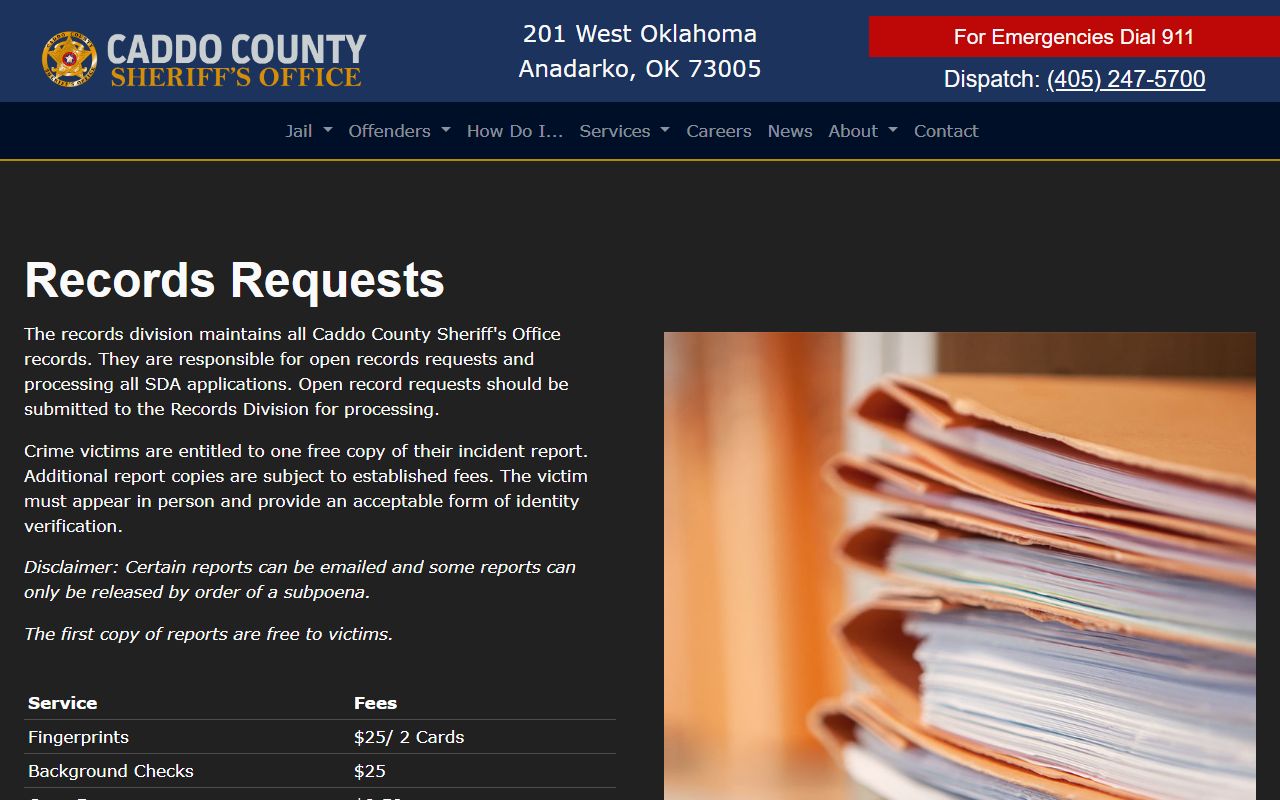
The Sheriff's Office runs a records division for report copies and open-records requests, and its records request page lists the fee schedule and the victim-copy policy.
Booking paperwork and incident reports sit on that law-enforcement side, kept apart from the charges a prosecutor later files in court. That split is the key to reading an arrest record correctly.
How to Find Caddo County Arrest Records
Filed charges in Caddo County show up in the district court case record. The main public path is the Oklahoma State Courts Network, known as OSCN. It is free, and it works one case at a time. Booking and custody detail still lives on the jail roster, so check the inmate side if you need raw arrest and intake fields. The court record is where the charges themselves take shape.
- Open the OSCN docket search and choose Caddo County District Court from the court list.
- Search by the defendant's name, or enter a case number if you already have one.
- Open the matching case and read the counts section, where each filed charge is listed.
- Check every charge for its statute code, severity level, and current status.
Oklahoma routes case access through OSCN on a case-by-case basis, and the On Demand Court Records system covers some courts that are not on OSCN. There is no verified statewide public portal that hands the general public a full criminal history on demand, so a wider charge search means pulling each Caddo County case or using a regulated background check.
The online docket is public information, but it is not the official record. The Caddo County Court Clerk holds the certified file. When a docket entry reads that a document is available at the Court Clerk's office, the next step is to contact that office rather than expect a download. Older or sealed Caddo County charge records may not show online at all, and a clerk request is the way to confirm what exists.
Filing Charges in Caddo County
The arresting agency starts the paper trail, but it does not decide the charges. In Caddo County the District Attorney for District 6, Jason Hicks, files or declines state criminal charges. The arrest report goes to the prosecutor, who reviews it and chooses what to file. The charge record opens when a charging document reaches the court clerk. Three documents do that job, and each one fits a different kind of case.
| Document | What It Is | Filed By | Common For |
|---|---|---|---|
| Complaint | A sworn accusation that opens a case | Officer or prosecutor | Misdemeanors |
| Information | The prosecutor's formal charging document | District attorney | Many felonies |
| Indictment | Charges returned by a grand jury | Grand jury | Serious felonies |
A felony usually moves forward on an Information after a preliminary hearing, while a grand jury Indictment is saved for the most serious cases. The District Attorney for District 6 handles this work for Caddo and three nearby counties. Inside the city of Anadarko, the Anadarko Police Department makes arrests and forwards its reports to the same prosecutor.
City and county arrests both feed the same charging process, since the district attorney files the formal counts no matter which agency made the arrest. That is why one office, not the police, controls what ends up on the charge record. The prosecutor can also decline to file at all, which means an arrest can happen with no court charge to follow.
Timing matters too. After an arrest, the defendant has an initial appearance, and the formal charges are read at arraignment. In a Caddo County felony, a preliminary hearing tests whether the evidence supports the charge before the case moves ahead. Each of those steps lands on the docket, so the charge record shows not just what was filed but how the case has progressed since the arrest.
Caddo County Charge Codes and Severity
Each charge ties to an Oklahoma statute and carries a severity level. The district court case number gives the first clue. A CF number means a criminal felony. A CM number means a criminal misdemeanor. Felonies carry the heaviest penalties, and misdemeanors are lower-level offenses. The counts section then lists each charge with its own statute code and, when shown, the date of the offense.
One arrest can produce more than one charge. A single Caddo County case may stack a felony with one or two misdemeanors that grew out of the same event.
- Felonies: the most serious offenses, filed under CF case numbers, carrying prison time and the largest fines.
- Misdemeanors: lower-level offenses, filed under CM case numbers, usually met with jail time, fines, or probation.
- Multiple counts: one booking can lead to several charges, so a case may list a felony next to one or more misdemeanors.
Caddo County Charge Status Explained
A charge is not fixed once it is filed. As a Caddo County case moves, the prosecutor can change it. Counts get added, swapped, or thrown out. The docket marks each change with a date and a code. Reading the status tells you where a charge stands right now, not where it started.
| Status | What It Means |
|---|---|
| Pending | The charge is filed and the case is still open. No final decision yet. |
| Amended | The prosecutor changed the charge, often its wording or the count. |
| Reduced | The charge was lowered to a less serious level, such as a felony to a misdemeanor. |
| Dropped | The prosecutor chose not to pursue the charge. |
| Dismissed | The court ended the charge, with or without the option to refile. |
| Nolle Prosequi | A formal notice that the prosecutor will not proceed on the charge. |
Note: A dismissed or dropped charge can still appear on the docket as a closed entry, so the record shows the charge was filed and then ended.
Statewide Charge History Lookups
Charges filed in Caddo County stay in the local district court record, but people often want a wider view. Oklahoma does not offer a single public portal that prints a full criminal history for the general public. OSCN and the On Demand Court Records system give case-by-case access across many courts. For sentenced state prisoners, the Oklahoma Department of Corrections offender lookup adds custody and supervision detail. None of those tools replaces the certified Caddo County file held by the Court Clerk.
A wider search outside Oklahoma is harder still. Charges from other states sit in their own court systems, and a Caddo County case will not surface there. The most reliable record of a charge filed in this county stays with the local district court, and a formal screening report fills the gap when a statewide picture is needed.
Charges vs. Convictions
Being charged is not the same as being convicted. A charge is an accusation, and the state still has to prove it. Many charges end without a conviction, through dismissal, acquittal, or a plea to a lesser count. An arrest record and a charge record can both exist for a case that never led to a guilty finding.
| Charge | Conviction | |
|---|---|---|
| Stage | An accusation | A verdict or accepted plea |
| Proof Needed | Probable cause | Beyond a reasonable doubt |
| Decided By | The prosecutor who files | A judge or a jury |
| Public Record | Yes | Yes |
| Can It Change? | Yes, it can be amended or dropped | Stands unless appealed or vacated |
Background Check Considerations
A docket search and a background check are not the same tool. Reading a Caddo County charge record on OSCN is fine for personal knowledge. Using a record to decide on hiring, renting, lending, or insurance is different, and federal law sets the rules for that use. A compliant background check comes from a screening company that follows the Fair Credit Reporting Act, verifies its data, and gives the subject a chance to dispute errors.
Important: This website is not a consumer reporting agency under the Fair Credit Reporting Act, and its records may not be used for credit, employment, housing, insurance, or other FCRA-regulated decisions.
Restricted Charge Records in Caddo County
Some charge records never reach public view. Oklahoma keeps juvenile court records confidential under 10A O.S. Section 2-6-102, so charges filed against a minor are shielded except for a narrow group of authorized users. Active investigations can also stay out of sight until charges are filed. The point of these limits is to protect young people and ongoing cases, not to hide finished outcomes.
Adults can ask a court to seal a record. An expungement under 22 O.S. Section 18 hides qualifying arrest and charge records from public searches, and Section 18a sets out the petition and order forms. A granted order can direct the court clerk and law-enforcement agencies to pull the record from public view, so a later OSCN search for the case may return nothing. Sealing is not the same as a simple dismissal, since a dismissed charge can still be visible on the docket unless it is later sealed.
Note: Filing logistics for a Caddo County expungement run through the District Court and the Court Clerk, and an attorney can confirm whether a case qualifies.