
Criminal Court Records in Caddo County
A criminal court record is the case file that opens the moment charges are filed against a defendant. In Caddo County, the Court Clerk is the official keeper of that file. The clerk's criminal division logs every document, hearing, and order tied to the case, and the file stays open until the court reaches a final outcome. The record is built around one case number, so each charge, plea, and ruling links back to that single file. The arrest by police is only the start. The court record is the formal account of what the prosecutor charged and how the court resolved it.
Most criminal cases in the county are heard in the District Court, the trial court for Oklahoma Judicial District 6. The District Court handles felonies, which carry case numbers that begin with CF, and misdemeanors, which use CM numbers. A felony is a serious crime that can bring prison time. A misdemeanor is a lesser offense with lighter penalties. City ordinance violations are different. Those go to the Anadarko Municipal Court, not the District Court. Some crimes in Indian country may fall under tribal or CFR court jurisdiction instead of the state court, so not every local offense produces a Caddo County District Court record.
Searching Caddo County Criminal Records
The main way to look up a Caddo County criminal case online is the Oklahoma State Courts Network, known as OSCN. It is a free state system that lists District Court dockets, including criminal felony and misdemeanor cases. A second portal, On Demand Court Records, or ODCR, covers many Oklahoma courts and handles some online payments. OSCN warns that its case pages are not the official record. For a certified or sealed document, the Court Clerk holds the true file.
- Open OSCN Docket Search at oscn.net/dockets/search.aspx.
- Choose "Caddo County District Court" in the court dropdown, then search by defendant name or case number.
- Narrow the results by case type, filing date, or citation number when a name returns many hits.
- Open a case to read the docket, counts, events, bond, and disposition.
- Request a certified copy from the Court Clerk when you need an official document for legal use.
Statewide access to electronic case information is given case by case through OSCN or ODCR under a 2009 Oklahoma Supreme Court directive, and bulk copying is not allowed. The charges within a case are covered in more detail by the Caddo County court charge records, while the full set of clerk filings, civil and family matters included, sits under Caddo County court records.
Stages of a Caddo County Criminal Case
A criminal case moves through set stages, and each one leaves a mark in the record. The docket lists them in order, so a reader can follow a case from the first filing to the last. The Caddo County criminal court record shows the date of each step, the judge assigned, and the result. Reading the stages in sequence is the clearest way to see where a case stands or how it ended.
Case flow: Charges Filed › Arraignment › Preliminary Hearing › Plea or Trial › Disposition › Sentencing
| Stage | What Happens |
|---|---|
| Charges Filed | The district attorney files an Information, or a grand jury returns an indictment, opening the case under a CF or CM number. |
| Arraignment | The defendant is told the charges and enters a plea of guilty, not guilty, or no contest. |
| Preliminary Hearing | In felony cases, the judge decides whether the evidence is strong enough to bind the case over for trial. |
| Plea or Trial | The case ends in a negotiated plea or goes to trial before a judge or jury. |
| Sentencing | After a guilty plea or verdict, the judge imposes the sentence, fines, and conditions. |
What a Caddo County Criminal Record Shows
The Caddo County criminal court record packs a lot of detail into one file. A felony docket can name the arresting agency and officer, the district attorney, and the defense attorney. It lists each count, the bond, the hearings, and the financial costs. The sample felony case State of Oklahoma vs. Edward J. Redden, number CF-2024-00119, shows the pattern. It was filed on May 15, 2024 before Judge David A. Stephens and listed counts for eluding a police officer, child endangerment by driving under the influence, DUI-drugs, and driving left of center.
| Field | What It Shows |
|---|---|
| Case Number | The unique court ID, such as CF-2024-00119; the CF prefix marks a criminal felony. |
| Defendant | The person charged, named in the case style as the State of Oklahoma versus the defendant. |
| Charges | Each count with its charge text, the statute when shown, and the date of the offense. |
| Plea | The defendant's formal answer to each count, such as guilty, not guilty, or no contest. |
| Disposition | The outcome of each count, from dismissal to conviction. |
| Sentence | The final order, including jail or prison time, suspended or deferred terms, fines, and payment plans. |
Note: Public OSCN views should not show Social Security numbers, full birth dates, or confidential juvenile details, even when the rest of the docket is open.
Charges vs. Convictions in Caddo County
Being charged is not the same as being convicted, and a Caddo County criminal court record keeps the two apart. A charge is an accusation. The district attorney files it after reviewing the police reports, and the office can amend, reduce, or drop counts as the case moves. In Caddo County, District Attorney Jason Hicks leads the District 6 office that prosecutes state charges in the District Court. A conviction comes only after a guilty plea or a guilty verdict. A record can show charges that were later dismissed or that ended in acquittal, so the final disposition carries more weight than the opening count.
The District Attorney's office decides which charges to file and how to pursue them. The Oklahoma District 6 District Attorney page lists the Caddo County office and the prosecutor who handles local criminal cases.
Because the prosecutor controls the charging decision, the counts in a court record reflect the state's case, not the final judgment of the court.
| Charge | Conviction | |
|---|---|---|
| Stage | Accusation | Verdict or plea |
| Burden of Proof | Probable cause | Beyond reasonable doubt |
| Public Record | Yes | Yes |
Reading Caddo County Dispositions and Sentences
In a Caddo County criminal court record, the disposition is the outcome of a charge, and the sentence is what follows a conviction. Common dispositions include guilty, not guilty, dismissed, and nolo contendere, which means no contest. Oklahoma records often show a suspended sentence or a deferred sentence. A suspended sentence means the defendant is convicted but does not serve the time in custody as long as the conditions are met. A deferred sentence delays the finding, and the case can be dismissed if the defendant completes the terms. In the Redden felony case, the record shows a five-year suspended sentence and a Rule 8 payment order of fifty dollars due each month.
Every criminal defendant has the right to a lawyer, and those who cannot afford one may receive appointed counsel. The Oklahoma Indigent Defense System provides that representation in many counties across the state. The Oklahoma Indigent Defense System page explains its mission and offers a Find My Attorney tool.
Appointed defense counsel appears in the court record the same way a private attorney does, listed by name, role, and the party represented.
Sealed vs. Expunged Caddo County Records
Some Caddo County criminal court records can be sealed or erased under Oklahoma law, but the two outcomes are not the same. A sealed record is hidden from public view, though some agencies keep limited access. An expunged record is treated as though it never existed. Adult expungement runs through Title 22 of the Oklahoma statutes, and a person usually files in the District Court where the case sits. A Caddo County case would route to the Caddo County District Court. Eligibility depends on the outcome, the waiting period, and any prior record, so relief is never automatic.
The expungement law spells out who qualifies to seal an Oklahoma criminal record. The official text of 22 O.S. Section 18 lists the categories of people eligible to apply.
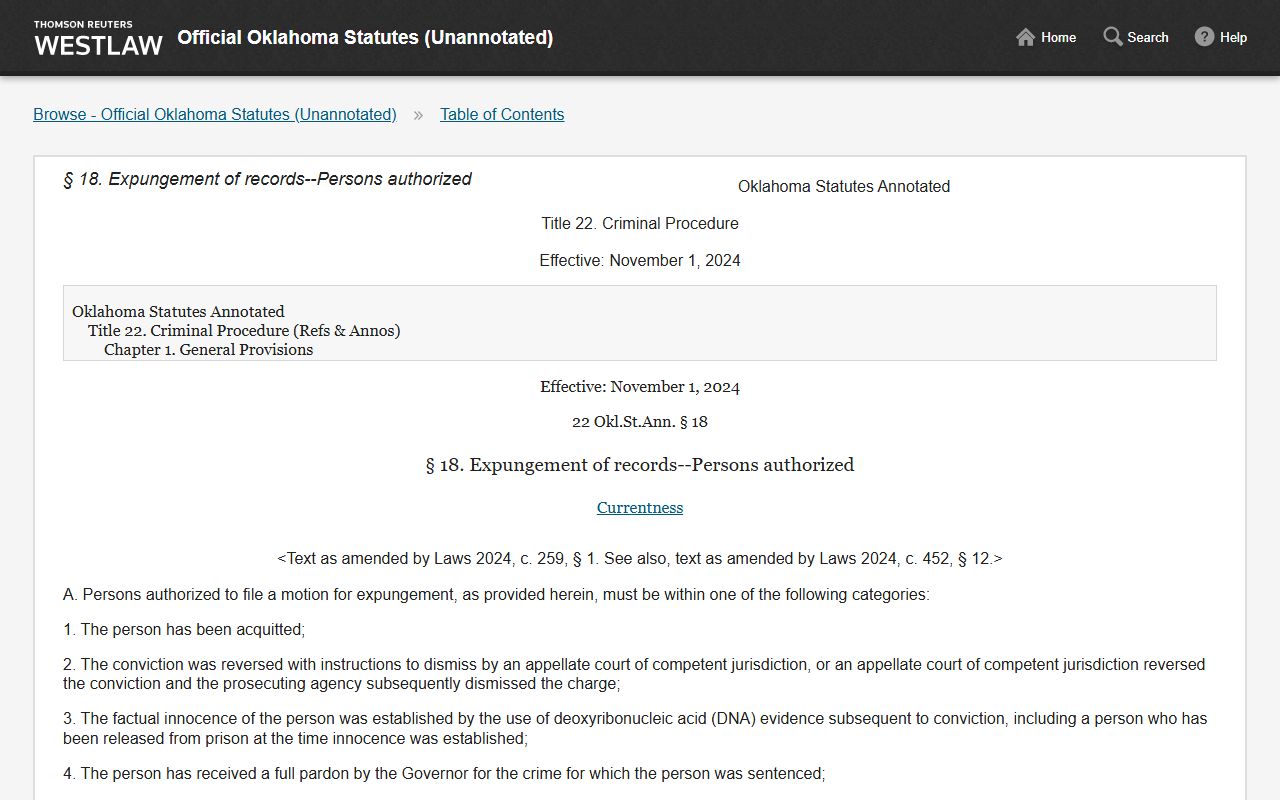
Once a court grants the order, public OSCN results for the case may disappear or show only limited information.
| Sealed | Expunged | |
|---|---|---|
| Visibility | Hidden from public | Treated as never existed |
| Law Enforcement | Limited access | Very limited |
| Eligibility | Court order under 22 O.S. 18 and 18a | Adult cases via 22 O.S. 18; juvenile via 10A O.S. 2-6-109 |
Note: Juvenile records use a separate expungement process under Title 10A, and that path runs through the same District Court that holds the juvenile case.
Public Access to Caddo County Criminal Records
Most Caddo County criminal court records are open to the public. Oklahoma's Open Records Act treats these court records as open for inspection and copying during business hours, unless a specific law makes them confidential. Electronic access to a Caddo County criminal court record is handled case by case through OSCN or ODCR. The online docket is public information, but it is not the certified record. For an official copy, the request goes to the Court Clerk.
Key Statutes:
Oklahoma Code § 51 O.S. 24A.5 - Public records are open for inspection and copying during regular business hours unless a law makes them confidential.
Oklahoma Code § 10A O.S. 2-6-102 - Juvenile court records are confidential and open only to qualified parties and officials.
Caddo County Criminal Background Checks
A casual Caddo County criminal court records lookup is not the same as a formal background check. Many employers and landlords must follow the federal Fair Credit Reporting Act when they use criminal court records to make decisions. That law sets rules for accuracy, notice, and the right to dispute. Reading a free OSCN docket for personal knowledge is fine. Using a Caddo County criminal record for hiring, housing, or credit falls under stricter rules and usually calls for a licensed screening service.
Important: Caddo County Court Records is not a consumer reporting agency under the Fair Credit Reporting Act, and its information may not be used for employment, tenant, credit, or insurance screening.
Restricted Caddo County Criminal Records
Not every Caddo County criminal court record is open. Juvenile court records are confidential under Oklahoma law, with access limited to eligible parties, officials, and the court. Sealed and expunged cases drop out of public view once a judge signs the order. Ongoing investigations, sensitive victim details, and mental-health filings may also be withheld or redacted. Personal identifiers such as Social Security numbers and full birth dates are kept off public copies. When a record is restricted, the Court Clerk or a court order is the only path, and for an active criminal matter a defendant should speak with an attorney.