
Caddo County District Court Overview
The District Court is the workhorse of the Oklahoma court system. Caddo County District Court hears felony and misdemeanor crimes, civil lawsuits, divorces, probate cases, guardianships, protective orders, and juvenile matters. It is a court of general jurisdiction, which means it can hear nearly any kind of case the law allows. Oklahoma runs 77 District Courts, one bench set for each county. The Caddo County bench sits at the courthouse in Anadarko, the county seat since 1901. You can review the court's public case information online through the Oklahoma State Courts Network.
Caddo County belongs to Judicial District 6. That district groups Caddo with Grady, Jefferson, and Stephens counties under one District Attorney, Jason Hicks. Judges work across the district, and the Caddo County Court Clerk keeps the local case files. A felony docket from this county can list the assigned judge, the parties, the charges, and every event in the case. Most of that detail is open to the public and free to view. For the current roster of judges, the state publishes a yearly Oklahoma Judicial Directory.
Courts That Serve Caddo County
Several courts touch the lives of Caddo County residents, and they sit at different levels. The District Court is the trial court where local cases begin. Above it are three appellate courts. Below it are the municipal court and, in some Indian-country matters, a tribal or CFR court. Oklahoma is unusual because it keeps two courts of last resort instead of one, splitting civil and criminal appeals between them. The table below maps each court, its role for Caddo County records, and where to reach it.
| Court | Role for Caddo County | Address or contact |
|---|---|---|
| Oklahoma Supreme Court | Final authority on civil appeals; oversees the whole court system | 2100 N. Lincoln Blvd., Oklahoma City, OK 73105 |
| Court of Criminal Appeals | Final authority on criminal appeals | Oklahoma City; see the Judicial Directory |
| Court of Civil Appeals | Hears civil appeals the Supreme Court assigns | See the Judicial Directory |
| Caddo County District Court | Trial court for felony, misdemeanor, civil, family, probate, and juvenile cases | 110 SW 2nd Street, Anadarko, OK 73005; (405) 247-3393 |
| Anadarko Municipal Court | City ordinance and municipal traffic citations | 501 West Virginia, Anadarko, OK 73005; (405) 247-2483 |
| Southern Plains CFR / tribal courts | Certain Indian-country matters that fall outside state jurisdiction | Southern Plains CFR Court, through the Bureau of Indian Affairs |
Note: The District Attorney for District 6 also covers Grady, Jefferson, and Stephens counties, so the same prosecutor's office handles Caddo cases.
How a Caddo County Case Moves
A Caddo County case does not jump straight to a high court. It starts at the trial level, then climbs only if a party appeals. Oklahoma splits its top courts in a way few states do. Civil appeals end at the Oklahoma Supreme Court. Criminal appeals end at the Court of Criminal Appeals, which is the last word on any state crime. The Court of Civil Appeals sits in the middle and takes the civil appeals the Supreme Court hands it.
The flow below shows the path a Caddo County case follows from the District Court bench up through the appellate level.
Criminal case: Arrest › First Appearance › Information or Indictment › Arraignment › Preliminary Hearing › Plea or Trial › Sentencing › Appeal to the Court of Criminal Appeals (last resort for crimes)
Civil case: Petition Filed › Answer › Discovery › Trial › Judgment › Court of Civil Appeals › Oklahoma Supreme Court (last resort for civil matters)
District Court, Municipal Court, and Tribal Court
Not every case belongs in District Court. A speeding ticket written inside Anadarko city limits goes to the municipal court. A misdemeanor by a tribal member on Indian land may fall to a tribal or CFR court instead of the state bench. These lines matter because they decide which records system holds the file. A search of state dockets will not always surface a city ticket or a tribal case.
| District Court | Municipal Court | Tribal / CFR Court | |
|---|---|---|---|
| Cases heard | Felonies, misdemeanors, civil, divorce, probate, juvenile, district traffic | City ordinance violations and municipal traffic | Certain misdemeanors involving Indians in Indian country |
| Where records sit | OSCN and the Caddo County Court Clerk | Anadarko Municipal Court clerk | The tribal or CFR court clerk |
| Appeals go to | Court of Criminal Appeals or Supreme Court | Stays local unless appealed under city rules | Court of Indian Appeals |
| On state OSCN dockets | Yes | No | No |
Note: Because Caddo County covers significant tribal and Indian-country land, some criminal matters never appear in the state OSCN dockets at all.
Caddo County Criminal and Civil Cases
The District Court splits its work into broad lanes. Criminal felony cases carry a "CF" case number, as the sample case CF-2024-00119 shows. Misdemeanor cases generally use a "CM" number. A criminal file can hold the arresting agency, the charges, bond terms, hearing dates, the plea, the sentence, and any payment plan. The State of Oklahoma is the named party against the defendant in these cases.
Civil cases run on a different track. They include lawsuits, money judgments, liens and garnishments filed in court, and protective orders. In a civil case the parties are a plaintiff or petitioner against a defendant or respondent. Public access depends on sealing and redaction rules, so some filings stay out of view even when the case is listed. You can search both lanes through the same portal and read the full file in the Caddo County court records.
Most events show up as dated docket lines. A single felony can carry counts for several offenses at once. The sample Caddo case, for instance, listed eluding an officer, child endangerment by driving under the influence, and a drug-related DUI in one filing.
Caddo County Probate and Family Cases
Probate runs through the Probate Division of the District Court. There is no separate surrogate's or orphans' court in Caddo County. Probate files can include wills, petitions for letters, orders admitting a will, the appointment of a personal representative, inventories, creditor notices, and final accountings. Guardianship and conservatorship cases live here too. The Court Clerk holds the official probate file and issues certified copies.
Family matters are also District Court business. Divorce, custody, child support, and protective orders are filed and heard at the courthouse in Anadarko. A divorce is searched as a court case by party name or case number. Sensitive material about children, finances, or protective orders may be sealed or redacted. Marriage licenses are a special case in Oklahoma. The county Court Clerk, not the County Clerk land-records office, issues and keeps them.
Anatomy of a Caddo County Felony Case
A real docket reads more clearly once you know its parts. Sample case CF-2024-00119 styled as State of Oklahoma vs. Redden, Edward J was filed on May 15, 2024, before Judge David A. Stephens. It is a criminal felony, and its docket holds nearly every field a Caddo County criminal record can show. Reading one case end to end teaches how to read them all. The same layout appears across the Caddo County court dockets published online.
The common fields on a Caddo County felony docket include the following.
- Case number and case style naming the State and the defendant
- Filing date, case type, and the assigned judge
- Parties such as the defendant, the District Attorney, and the arresting officer and agency
- Counts that list each charge, with the offense text and disposition
- Events like the preliminary hearing, plea, and sentencing
- Financial lines for court costs, fines, victim compensation, and payment plans
- Bond amount and the final disposition or sentence
In the sample, the docket showed a $5,000 bond, a guilty plea, a five-year suspended sentence, and a monthly payment order. OSCN warns that its online docket is not the official record, so a certified copy from the Court Clerk is needed for any legal use.
Caddo County Sheriff and the Docket
The Sheriff's Office is the county's law-enforcement arm, and its arrests and service of process feed the District Court's criminal docket. When a deputy makes a felony arrest, the case can land in front of a Caddo County District Court judge within days. The agency is led by Sheriff Spencer W. Davis, whose official biography describes a lifelong Caddo County resident with more than 43 years in law enforcement.
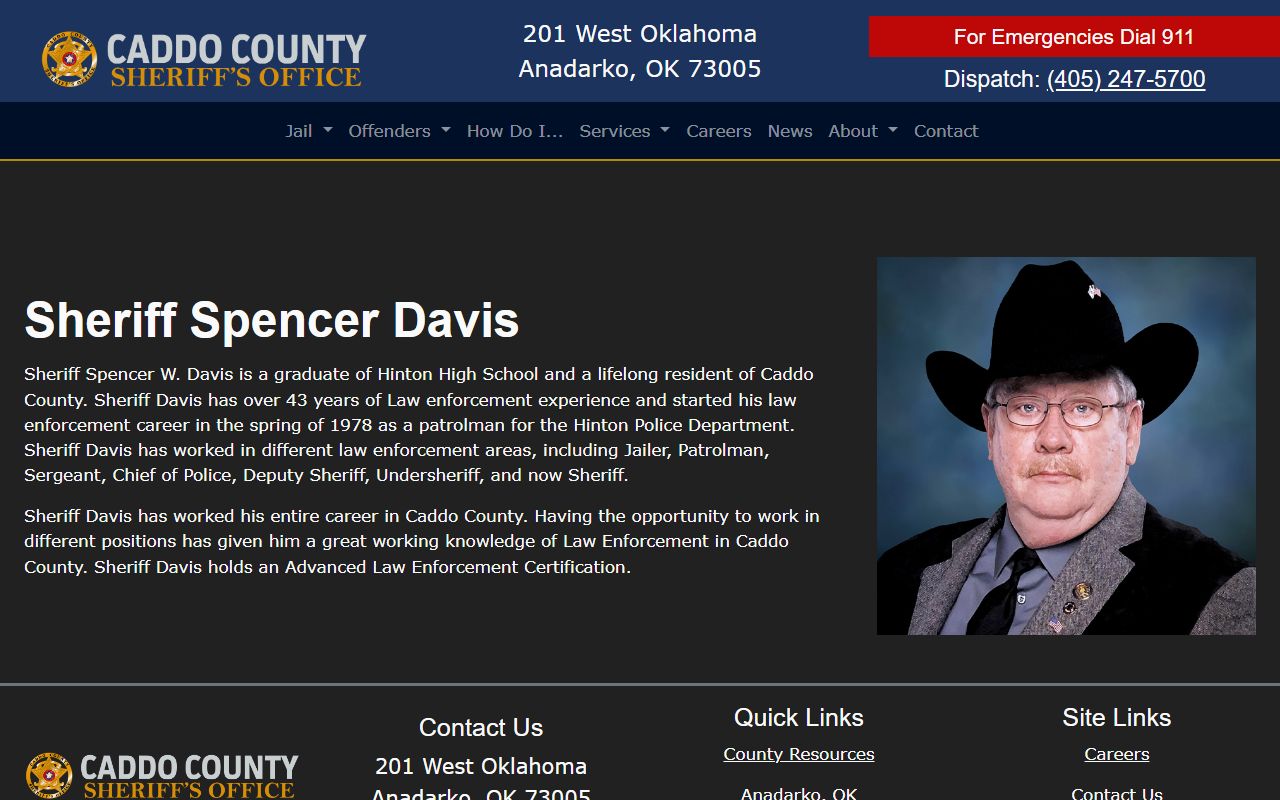
In the sample felony docket, the Caddo County Sheriff's Department appears as the arresting agency and a deputy is listed as a party. That link between the sheriff and the court is direct. The reports a deputy files become the starting point for the charges the District Attorney later files in District Court.
Registry and Restricted Court Records
Not every court-related record is fully public. Some sit behind statutory limits, and the sheriff maintains one of the best known restricted lists. Under state law, the office publishes a county sex-offender page that ties back to convictions handled in District Court. The county registry page cites Oklahoma's sex-offender statutes and links out to the state and national registries.
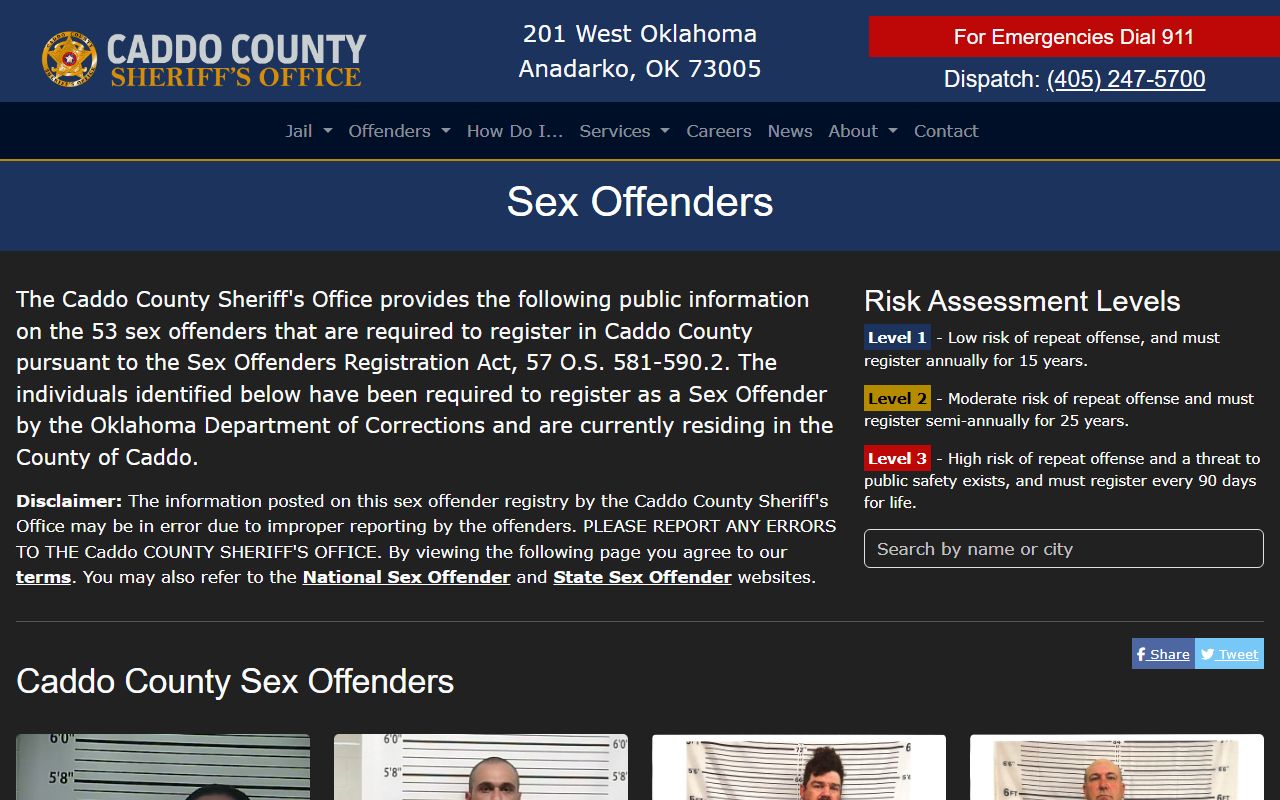
Other District Court records are confidential by statute. Juvenile cases, sealed and expunged files, adoption matters, and many mental-health filings stay out of public view. A person seeking to expunge a Caddo County record files in the same District Court that holds it. For active criminal matters, court-appointed counsel may come through the state indigent-defense system rather than a county office.
Caddo County Detention and Cases
The Detention Center holds defendants whose cases move through the District Court. A person booked into the Caddo County jail after a felony arrest may wait there for a first appearance, a bond hearing, or a plea. The jail and the court work in step, since custody status often shapes how fast a case advances. Several outside vendors run the jail's money and communication tools, and each connects family members to a defendant whose case is pending in District Court.
Phone calls and video visits run through City Tele Coin. Family members set up a prepaid account on the City Tele Coin site to stay in contact with someone in custody.

Money for an inmate's account is handled through a separate deposit service. Senders place funds online through the commissary deposit portal, which credits the account of a defendant awaiting a District Court hearing.
Ordering commissary items uses yet another portal. Family and friends buy goods for an inmate through the commissary order site, with orders due by Thursday morning for Friday delivery. None of these tools replace the court file, but they support the people whose cases sit on the District Court docket.
Court Clerk and District Attorney
Two offices matter most for District Court records. The Court Clerk keeps the case files, dockets, marriage licenses, and probate records, and issues certified copies. The District Attorney files and prosecutes the criminal charges that fill the felony and misdemeanor dockets. Both work out of the same courthouse in Anadarko.
Patti Barger
110 SW 2nd Street
Anadarko, OK 73005
Phone: (405) 247-3393
Fax: (405) 247-4127
Hours: Mon-Fri 8:30am-4:30pm
Jason Hicks, District Attorney
110 S.W. 2nd Street, Suite 108
Anadarko, OK 73005
Phone: (405) 247-3372
Fax: (405) 247-2592
The District 6 page lists the Caddo office along with bogus-check, restitution, and supervision payment links. In the sample felony case, Jason Hicks is named as the District Attorney handling the prosecution.
History of the Caddo County Courthouse
Caddo County was organized on August 6, 1901, when the area opened by lottery to non-Indian settlers. The county name comes from the Caddo tribe and the word "kaadi," meaning chief. Anadarko became the county seat and remains the courthouse city today. The Oklahoma Historical Society records that early county business was run from a tent on the courthouse square.
The buildings came fast after that. A one-story wood-frame courthouse went up late in 1901, a second story followed in 1902, and work began that year on a three-story brick courthouse. The county lost land to Grady County at statehood in 1907 and again in 1911. That long history links today's case search to court operations that began in the county's first years. The state's two courts of last resort, a feature explained in the Historical Society's judiciary overview, still sit above the Caddo County District Court as they have for generations.